
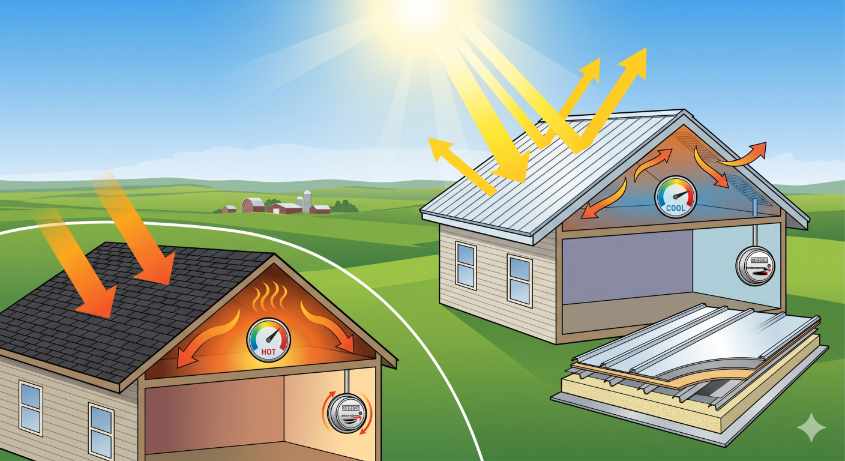
While North Dakota winters dominate discussions about building durability, our summers present a different financial challenge. July and August bring intense sunlight and high temperatures that place heavy demands on residential cooling systems. Choosing metal roofing is a highly effective way to manage these seasonal energy spikes. By utilizing advanced reflectivity and thermal physics, a modern steel roof acts as an active radiant barrier, lowering attic temperatures and reducing cooling costs.
At Vander Wal Contracting, we engineer high-performance metal roofing systems designed for year-round efficiency. Understanding the science of solar reflectance and thermal emittance can help Bismarck-Mandan homeowners make an informed choice that delivers measurable utility savings during the summer months.
Solar Reflectance vs. Thermal Emittance
The energy efficiency of a metal roof depends on two critical properties: solar reflectance and thermal emittance.
Solar Reflectance: The ability of a roofing material to reflect solar energy back into the atmosphere before it is absorbed as heat.
Thermal Emittance: The relative ability of a roof surface to re-radiate its absorbed heat energy into the atmosphere rather than transferring it down into the building.
Traditional dark asphalt shingles absorb up to 90% of solar radiation. This trapped energy heats the roof deck and transfers directly into the attic insulation, creating an “oven effect” that forces your air conditioning system to run continuously.
Modern steel roofs feature specialized pigment coatings, such as PVDF (Kynar 500), that reflect a substantial percentage of solar rays. Even dark-colored metal roofs can be engineered with these “cool pigments” to achieve high reflectivity without sacrificing curb appeal.
The Attic Heat Transfer Cycle
When heat is absorbed by an asphalt roof, it radiates downward into the attic space. Even with thick insulation, this heat eventually transfers into your living spaces through ceilings and walls.
The Step-by-Step Cooling Process of Metal:
- Reflection: Solar radiant energy hits the metal panel and is largely reflected away immediately.
- Re-radiation: The small percentage of heat that is absorbed is rapidly emitted back into the sky due to steel’s high thermal emittance.
- Attic Mitigation: Because the metal cools quickly when the sun shifts or a breeze blows, the roof deck underneath remains significantly cooler.
- Ventilation Support: Any residual heat is easily flushed out through a balanced attic ventilation system, protecting your insulation from thermal overload.
Performance Comparison: Metal vs. Dark Asphalt in Summer
| Metric | Dark Asphalt Shingles | Cool Metal Roofing (PVDF) |
| Solar Reflectance | 5% to 15% | 25% to 65%+ |
| Peak Attic Temperature | Up to 140°F – 150°F | Up to 100°F – 110°F |
| Surface Temperature Change | Retains heat long after sunset | Cools instantly in shade/evening |
| Average Cooling Savings | Baseline | 10% to 25% Reduction |
Year-Round Thermal Efficiency
The exact physical properties that make metal roofing an excellent summer insulator also support winter performance. While it reflects the sun in July, it forms a critical layer of a weather-tight envelope in January.
When paired with a layer of continuous rigid foam insulation and meticulous moisture management, a standing seam or high-rib metal roof eliminates thermal bridging. This complete system prevents indoor heat from escaping during brutal cold snaps, meaning your investment reduces utility costs in both seasons.
Frequently Asked Questions
Will a metal roof make my house hotter in the winter by reflecting the sun?
No. In a North Dakota winter, the angle of the sun is low, and roofs are often covered in snow. Your winter energy efficiency is driven by your attic insulation and proper ventilation, not solar absorption through shingles.
Do I have to choose a white or light-colored roof to get energy savings?
While light colors offer the highest reflectivity, modern “cool roof” pigments allow dark grays, greens, and browns to reflect invisible infrared light. You can achieve excellent energy savings while matching your neighborhood’s style.
How much can I realistically save on my power bill?
Depending on your home’s orientation, insulation levels, and shading, a cool metal roof can reduce summer cooling costs by 10% to 25%.
Does a metal roof require special maintenance to keep its reflectivity?
Premium PVDF coatings resist dust accumulation, chalking, and fading. A simple rain shower is usually enough to keep the surface clean and reflective for decades.
What is the “Cool Roof Rating Council” (CRRC)?
The CRRC is an independent organization that tests and rates the solar reflectance and thermal emittance of roofing products. We use materials that are rigorously tested to ensure performance.
Can I install a metal roof over existing asphalt to improve insulation?
While possible, Vander Wal Contracting generally recommends a complete tear-off. This allows us to inspect the decking, optimize your sub-layers, and ensure the best thermal performance.
Building with accuracy and intent means understanding the long-term interaction between your home and the elements. At Vander Wal Contracting, we don’t just replace roofs; we engineer long-term efficiency solutions for North Dakota homeowners. If you are ready to lower your seasonal energy bills and protect your property with a permanent exterior, contact us today for a detailed roofing estimate.
By: Vander Wal Contracting Editorial Team
Last Updated: May 28, 2026
Credentials: Bismarck’s roofing and exterior specialists focusing on climate-resilient engineering and energy-efficient building practices.