
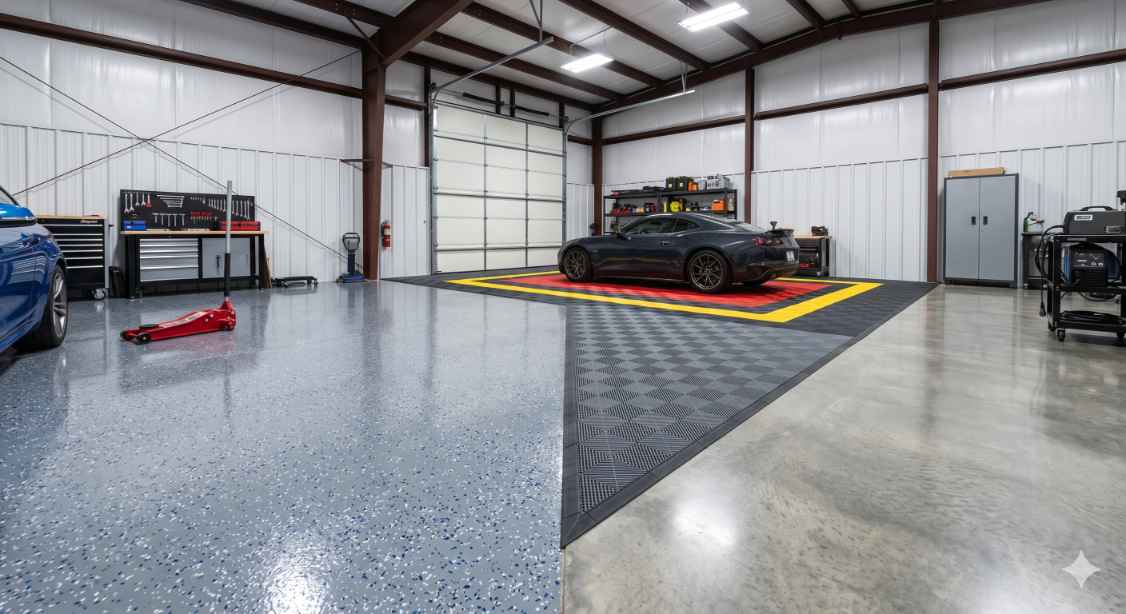
Investing in a commercial or personal shop condo in the Bismarck-Mandan area represents a major asset for your business, vehicle collection, or hobby space. While structural framing and overhead clearance dominate the early design phases, the surface beneath your feet directly dictates the daily utility, safety, and long-term resale value of the property.
Your shop floor must endure heavy point loads, chemical spills, automotive fluids, and the relentless tracking of dirt, snow, and road salt characteristic of North Dakota winters. Choosing the right floor finish with accuracy and intent means looking past initial aesthetics to analyze subfloor engineering, maintenance demands, and structural durability.
Sealed and Polished Concrete
Every shop condo begins with a structural concrete slab. Leaving that slab raw and unprotected invites staining, dusting, and moisture absorption. However, professional sealing or mechanical diamond polishing transforms standard concrete into a high-performance floor.
- The Merits: Sealed or polished concrete is exceptionally cost-effective and highly durable. It easily withstands heavy point loads from vehicle lifts, agricultural trailers, and heavy machinery without scratching or denting. It is completely non-combustible, making it an excellent choice for fabrication and welding bays.
- The Regional Challenge: Untreated concrete is highly porous. During a North Dakota winter, vehicles track in snow mixed with road salt and de-icing chemicals. If the concrete is not sealed correctly, this moisture seeps into the pores. When temperature cycles fluctuate below freezing, the trapped water expands, leading to surface spalling, pitting, and structural degradation.
- The Verdict: An excellent, budget-conscious option for heavy industrial work, provided a high-solid, chemical-resistant penetrating sealer is applied and reapplied periodically.
Epoxy and Resin Coatings
For high-end shop condos, detailing bays, and premium storage spaces, multi-layer epoxy or polyaspartic resin coatings represent the gold standard. These systems involve a chemical reaction that bonds a rigid plastic coating directly to the prepared concrete substrate.
- Seamless Impermeability: Epoxy creates a completely seamless, non-porous barrier. If an engine drops oil, a battery leaks acid, or road salt melts off a truck, the fluids sit on top of the coating where they can be wiped away effortlessly.
- Enhanced Brightness: High-gloss epoxy coatings reflect overhead LED high-bay lighting efficiently. This maximizes the lumen output of your shop, eliminating dark shadows underneath vehicles and creating a professional, clean-room aesthetic.
- Slip and Impact Resistance: Professional installers incorporate decorative color flakes or quartz silica sand into the wet base coat. This adds texture to the surface, providing essential slip-resistance when shoes or tires track rain and slush onto the floor.
- The Verdict: The premier choice for vehicle storage, workspaces, and commercial shop condos where aesthetics, chemical resistance, and effortless maintenance are paramount.
Rigid Interlocking Tiles
Modular flooring consists of heavy-duty interlocking tiles made from high-impact polypropylene or flexible PVC rubber. These tiles snap together tightly over a standard concrete slab without adhesives.
- Design and Installation: Interlocking tiles offer unmatched design flexibility, allowing you to create custom borders, parking grids, and multi-color patterns. Because they require zero chemical curing time, you can drive heavy vehicles onto the floor immediately after assembly.
- Ergonomics and Sound Dampening: Walking on a rigid plastic or rubber tile floor provides slight structural deflection compared to solid concrete, significantly reducing fatigue on your joints during long working hours. The material also absorbs acoustics, dampening the echo of air tools and machinery.
- The Sub-Floor Vulnerability: While the top surface remains durable, interlocking tiles feature open or semi-flexible seams. In our regional climate, melted snow and road brine will eventually migrate through the seams, settling on the concrete below. Without regular drainage or pulling up tiles to dry the slab, this trapped moisture can cause hidden concrete rot or mold growth.
- The Verdict: Ideal for dedicated detailing bays, hobby areas, and showrooms where comfort and style are prioritized over heavy welding or fluid-heavy mechanics.
Comparison of Shop Condo Flooring Systems
| Performance Metric | Sealed Concrete | Epoxy/Resin Coatings | Interlocking Tiles |
| Impact & Load Capacity | Industrial / Extreme | High / Excellent | Medium / Heavy |
| Chemical & Salt Resistance | Moderate (Requires Sealer) | Impervious / Maximum | High (Sub-slab Vulnerability) |
| Slip Resistance | Low (Smooth) to High (Broom) | High (With Aggregate Additive) | High (Engineered Tread) |
| Maintenance Profile | Low (Occasional Resealing) | Extremely Low (Sweep & Mop) | Moderate (Requires Sub-surface Vacuuming) |
| Visual Customization | Minimal | Unlimited Colors & Flakes | Unlimited Modular Patterns |
Frequently Asked Questions
Why is moisture vapor testing critical before applying epoxy to a shop floor?
Concrete slabs naturally exhale moisture vapor from the earth beneath them. If an epoxy coating is applied to a slab with high moisture emission, the vapor pressure becomes trapped underneath the seamless plastic barrier, resulting in unsightly blistering, bubbling, and eventual delamination of the coating.
Can I weld or use a plasma cutter on an epoxy or plastic tile floor?
Welding slag and grinding sparks can pit, melt, or scorch epoxy coatings and polypropylene tiles. If your shop condo will see heavy hot-work fabrication, polished concrete is the safest and most resilient option for that specific work zone.
How long does a professional epoxy floor take to cure before I can drive on it?
While light foot traffic is often permitted within 24 hours of application, full chemical curing typically takes 3 to 7 days depending on regional temperature and humidity levels. Driving heavy vehicles or parking trailers on the floor too early can cause hot-tire pickup, permanently marring the finish.
Will road salt ruin a polished concrete floor?
Yes, if left unsealed. While polishing hardens the upper wear layer of the concrete, it does not make the surface completely non-porous. Road salt combines with water to form a corrosive brine that breaks down the calcium silicate hydrate in the concrete, causing surface etching and weakening the slab structure.
How do temperature drops affect shop floors with in-floor hydronic heating?
If your shop condo utilizes in-floor radiant heat, it maintains a warm, consistent slab temperature. This setup is highly beneficial for epoxy and sealed concrete coatings, as it prevents extreme thermal contraction and expansion, eliminating the risk of hairline structural cracking along cold joints.
Maximizing the utility and long-term value of your shop condo means engineering the space from the foundation up. At Vander Wal Contracting, we assist owners in developing commercial property assets, high-bay workshops, and shop condos tailored specifically to the structural and atmospheric demands of the Bismarck region. Contact us today to discuss your building goals and lay the groundwork for a permanent, high-performance workspace.
By: Vander Wal Contracting Editorial Team
Last Updated: June 22, 2026
Credentials: Local specialists in custom post-frame construction, shop condo development, and climate-resilient exterior engineering in the Bismarck area.